
Commonwealth of Virginia
Office of the Attorney General
Jay Jones
Attorney General
202 North 9th Street
Richmond, Virginia 23219
804-786-2071
FAX 804-786-1991
Virginia Relay Service
800-828-1120
For media inquiries only, contact:
Rae Pickett
RPickett@oag.state.va.us
WHAT VIRGINIANS ARE SEEING: ATTORNEY GENERAL JAY JONES SHARES WEEKLY ROUNDUP OF ACTIONS TAKEN
Secures Legal Victory in Federal Overreach Attempt, Reaffirms Commitment to Free and Fair Elections, and Spotlights Outreach Team
RICHMOND, Va. -- Attorney General Jones continues to work for all Virginians, successfully pushing back against federal overreach and addressing election security and protection. Also, this week, Attorney General Jones marked Hispanic Heritage Month with a first-of-its-kind celebration and spotlights the incredible work of the Outreach team.
Fighting Back Against Federal Overreach
Attorney General Jones secured a legal victory in the fight to defend Virginia’s in-state tuition law, after a federal court sided with the Commonwealth. Attorney General Jones also addresses a federal attempt to gut Head Start and shares message ahead of Election Day.
PRESS RELEASE: Attorney General Jones Secures Major Legal Victory Upholding Virginia’s In-State Tuition Law
“Today’s ruling is a win for Virginia’s students and for our Commonwealth’s future. When I took office, I promised the people of the Commonwealth that I would reverse my predecessor's position and fight back against the Trump administration's attacks on our students and institutions of higher education. I’m proud to say that today we did just that,” said Attorney General Jones. “Students who grow up in Virginia and whose families contribute to the state’s tax base deserve access to affordable, in-state higher education, and this ruling affirms that Virginia is best equipped to make that decision, not Donald Trump. This office will never stop fighting to protect every student who calls Virginia home.”
WRIC: Virginia secures legal victory in fight to defend in-state tuition for undocumented, refugee students
Virginia was handed a significant legal victory in its fight to defend its law that allows qualifying undocumented and refugee students to pay in-state tuition rates.
On Monday, Oct. 5, a federal judge ruled in Virginia’s favor — and against the U.S. Department of Justice (DOJ) — in a lawsuit challenging the state’s in-state tuition policies, according to a press release from Attorney General Jay Jones’ (D) office.
The DOJ initially filed this lawsuit on Dec. 29, 2025, claiming these tuition aid policies for migrants violate federal law. It further alleged that these policies discriminate against U.S. citizens and incentivize illegal immigration.
Courthouse News: Judge scraps Trump challenge to in-state tuition for immigrant students in Virginia
In the latest case over the Trump administration’s attempt at leveraging the Constitution’s supremacy clause against state immigration policy, a federal judge upheld a Virginia law creating in-state tuition rate pathways for immigrant university students on Monday.
Granting summary judgment to the commonwealth, Senior U.S. District Judge Robert Payne found both the domicile pathway and the tuition equity pathway of 2020’s Virginia Dream Act aren’t preempted by federal law as the government claimed.
The federal government had cited the 1996 Illegal Immigration Reform and Immigrant Responsibility Act, which forbids states from offering tuition benefits for immigrant students based on residence within a state without offering the same benefit to out-of-state citizens.
Payne, a George H.W. Bush appointee, said the domicile-based, in-state tuition provision doesn’t apply to immigrants because of guidance from the state-empowered State Council of Higher Education for Virginia, which stated immigrant students categorically cannot have a Virginia domicile.
"Because undocumented students are not eligible for in-state tuition under the domicile pathway, the domicile pathway law is neither in conflict with, nor preempted by, Section 1623 (a)," Payne said. “The domicile pathway does not positively state or confirm that undocumented students are eligible for in-state tuition. It does not expressly state that undocumented students are eligible for in-state tuition. It is silent as to the effect of immigration status.”
Though the federal government argued the tuition equity pathway’s conditions create a residency requirement, the judge similarly dismissed those claims because it is not based on an student’s residence.
"It is based on high school attendance in Virginia, graduation from a high school in Virginia, passage of an equivalency test, or income tax return filings," Payne said. “The tuition equity pathway is both under- and overinclusive of Virginia residency and is not, as the United States claims, a ‘proxy’ for residency.”
Payne said the pathway is underinclusive because not all Virginia residents would necessarily qualify.
Payne offered an example of a Virginia resident who attends private school in another state as someone who doesn’t qualify. Payne said the policy is overinclusive because non-resident legal citizens can qualify, such as residents of Maryland or West Virginia who attend school across the Virginia border.
"The tuition equity pathway does not, directly or indirectly, provide in-state tuition ‘based on residence,’" Payne said. “Instead, it provides a number of ways for non-residents to qualify for in-state tuition. And, none of those ways are ‘based on’ residence.”
Payne further agreed with the commonwealth that the policy complies with federal law because the state provides other ways for non-residents to receive in-state tuition. The academic common market pathway, for instance, is available to students from any of the 14 states in the Southern Regional Education Compact, so long as they seek a degree in a program not available in their home state.
Average annual undergraduate tuition in the 2025-2026 school year was just shy of $10,000 for in-state students, while out-of-state students paid over $28,000, not including room and board, according to the Virginia State Council of Higher Education. A little over 1,200 students not domiciled in Virginia used the Virginia Dream Act to qualify for in-state tuition last school year.
The Trump administration has sued states including New Jersey, Minnesota, California and Illinois over similar tuition assistance programs.
"Today’s ruling is a win for Virginia’s students and for our commonwealth’s future," Virginia Attorney General Jay Jones said in a statement. “Students who grow up in Virginia and whose families contribute to the state’s tax base deserve access to affordable, in-state higher education, and this ruling affirms that Virginia is best equipped to make that decision, not Donald Trump.”
Former Virginia Attorney General Jason Miyares, a Republican, previously asked the court to declare the Virginia Dream Act invalid with just over two weeks left in office.
Payne noted that the federal government is likely to appeal. Representatives from the Justice Department did not respond to a request for comment.
Augusta Free Press: Federal court sides with AG on Trump administration challenge to Virginia Dream Act
Attorney General Jay Jones won a federal court victory in a suit brought by the Trump administration challenging the state’s Virginia Dream Act, which qualifies undocumented students for in-state tuition rates under certain conditions.
The attorney general’s office, when it was run by a MAGA, Jason Miyares, had attempted to invalidate the law through a consent decree with the Trump administration signed as the Miyares folks were cleaning out their offices in January.
“Today’s ruling is a win for Virginia’s students and for our Commonwealth’s future. When I took office, I promised the people of the Commonwealth that I would reverse my predecessor’s position and fight back against the Trump administration’s attacks on our students and institutions of higher education. I’m proud to say that today we did just that,” Jones said, per a statement from his office.
The Virginia Dream Act, signed into law in 2020, qualifies undocumented students for in-state tuition at public colleges and universities in the Commonwealth who:
-
attended high school in Virginia for two years
-
graduated from a Virginia high school or passed an equivalent exam
-
have a parent or guardian that has filed state income tax returns for at least two years before the date of registration
“Students who grow up in Virginia and whose families contribute to the state’s tax base deserve access to affordable, in-state higher education, and this ruling affirms that Virginia is best equipped to make that decision, not Donald Trump. This office will never stop fighting to protect every student who calls Virginia home,” Jones said.
PRESS RELEASE: Attorney General Jones Opposes Trump Administration’s Gutting of Head Start Standards for Virginians
“It truly does take a village to raise children and as a dad I know that every parent and every child deserves support. For so many, Head Start is a vital piece of that village. If implemented, this rule will leave the futures of Virginia’s children hanging in the balance of an increasingly strained childcare system,” said Attorney General Jay Jones. “The Trump administration is working to leave behind a legacy of disenfranchisement and broken infrastructure. My office will never stop fighting to protect the programs that help our families.”
Richmond Times Dispatch: Virginia will defend its voters and elections
Our confidence in our elections is earned by those who put in the work. The commonwealth has thousands of bipartisan election administrators who, applying detailed rules and procedures, ensure that eligible voters can cast ballots and that vote counts are accurate. Local registrars, electoral boards and poll workers carry out their duties with care. The result is a record of successful elections going back years, reflecting the patient, exacting work of public servants who understand the enormous responsibility placed upon them.
This year, the Trump administration has repeatedly sought to disrupt our election officials’ preparations. When President Trump attempted to use the United States Postal Service to restrict mail voting for the upcoming general election, Virginia joined other states in court. It successfully secured a consequential victory at the Supreme Court. And while the legal fight over mail voting will continue after this election, our victory ensured that the president’s illegal order did not disrupt the crucial work of election administrators across the commonwealth. Critically, not a single Virginian was disenfranchised. Trump’s signature does not place an order above the law.
[...]
The current assault on our free elections is why preparation starts long before Election Day. Attorneys in my office are studying the threats and preparing to respond alongside state and local officials. They know the law and will be ready to act. Working with the Department of Elections, we will use every legal tool available to protect the sanctity of Virginia’s elections.
Our obligation extends to every eligible voter, including those who disagree with me or align with a different political party. Every ballot deserves the same protection, regardless of who the vote is cast for. I will readily fulfill my duty as attorney general to defend your right to vote, however you may choose.
Trump can keep testing the limits of his power. Virginia will keep holding him to the Constitution. Anyone else contemplating interference should expect the same resolve. Two hundred fifty years after independence, self-government and democratic principles still depend on people being free to choose their leaders. In Virginia, we intend to keep those choices free.
Protecting Virginians
Attorney General Jones continued working to protect Virginians, calling on Congress to better regulate AI and recruiting top talent to work for the people of the Commonwealth.
Virginia Lawyers Weekly: Jay Jones among AGs asking Congress to rein in AI research
Attorney General Jay Jones is among a bipartisan group of 26 attorneys general asking Congress to establish federal regulations and safety protocols for frontier artificial intelligence.
“The capabilities, use, and adoption of AI in the public and private sectors have continued to proliferate, and communities around the nation are wrestling with how to balance meaningful technological advancements with the very real and serious threats we face as a result of those advancements,” Jones said in a statement to Virginia Lawyers Weekly. “One thing is crystal clear- Congress must do its job to develop a regulatory framework establishing clear safety protocols to protect our communities.”
The coalition wrote a letter to House Speaker Mike Johnson and the minority leaders in the House of Representatives and Senate on Sept. 23 urging the leaders to take action.
“Recent developments show that unchecked AI endangers Americans and could soon threaten our financial system, critical infrastructure, and national security,” the coalition wrote. “Although we are working to hold frontier AI labs accountable under existing state laws, federal oversight is urgently needed to prevent future disasters.”
The recent developments the coalition cites in its letter include the July reports that OpenAI agents escaped a testing environment and attacked Hugging Face, an open-source library and repository, via stolen credentials.
“When humans engage in such activity, they violate criminal law,” the coalition wrote.
The coalition also expressed concerns that OpenAI initially minimized the Hugging Face incident and claimed OpenAI restricted safety researchers in conducting a post-mortem of the incident.
Following the Hugging Face incident, other AI developers disclosed their AI agents had engaged in similar conduct, described by the coalition as “dangerous and unlawful actions.” The conduct included an Anthropic AI model uploading malware onto a public platform and the breach of an undisclosed third-party platform by Meta AI.
The coalition wrote that it believes frontier AI labs have been aware of this behavior, calling it “agentic misalignment.”
With the recent incidents in mind, the coalition wrote that the time is now for federal action, noting that earlier in September, Anthropic reported discovering examples of its AI models being used to “develop and power conventional and biological weapons, spy on sovereign nations, and fuel global cybercrime.
“If AI labs cannot prevent their models from conducting harmful and illegal activity, allowing them to release their models into the hands of bad actors only guarantees catastrophe,” the coalition wrote.
Frontier labs themselves and people who work in the industry are also calling for regulation, sometimes with grave warnings attached to the pleadings. The coalition cited the resignation of researcher Jacob Coxon from Anthropic in September, when he warned that those building AI “earnestly believe that it could kill us all by the end of the decade.”
The coalition said the calls for federal intervention are “clear and urgent”.
“We should use this moment to hold them to these statements,” the coalition wrote, adding that regulation is the only way to ensure AI frontier labs “act in the best interests of humanity, instead of their bottom lines.”
The coalition proposed specific actions, including mandatory federal oversight of safety training and standards, transparent and uniform government-led incident response, mandatory safety trainings and international cooperation to pace AI advancement to “prevent the development of harmful superintelligence.”
The coalition also requested “explicit preservation” of state authority in any federal policy. It specifically asked that no federal laws preempt state law and requested state officials be empowered to fully enforce federal protections.
“We are actively working to hold AI labs accountable under our respective state laws — including fairness obligations and AI-specific safety requirements — and we will continue to do so,” the coalition concluded. “But federal action is urgently needed to achieve the national and international coordination required to prevent catastrophic harm.”
WVTF: AG Jones seeking out former federal attorneys for his federal overreach unit
“Whether it be to protect them from the illegal tariffs the president continues to try and push, to the damage left behind from DOGE; we are ready to take this challenge head on,” Attorney General Jay Jones said of his new federal overreach unit’s purpose. He’s already recruited some former federal attorneys, but he wants more.
“This group will have people who are very, very well versed in the federal system, have extensive experience in federal courts and will be on the front lines putting Virginians first,” Jones said.
Celebrates Hispanic Heritage Month
Attorney General Jones celebrated Hispanic Heritage Month by hosting Latino state and local leaders, political appointees, and community organizations at the Barbara Johns Building. The event is the first-of-its-kind in the Office’s history. Attorney General Jones delivered remarks alongside Delegate Elizabeth Guzmán, Delegate Alfonso Lopez, Deputy Solicitor General Ethan Padilla Fallon, and Communications Director for the Office of the Attorney General, RaeAnn Roca Pickett.
PRESS RELEASE: Attorney General Jay Jones Hosts First-of-its-Kind Hispanic Heritage Month Celebration in OAG History
“Many in the Latino community continue to face barriers to opportunity and challenges in accessing institutions that should serve everyone equally. Those experiences are real, and they matter. This office holds space for that truth. This office also holds space for hope – a hope that’s reflected in the leaders from this community who work every day to strengthen justice, expand opportunity, and make sure every Virginian is truly seen and heard. That commitment guides our work in this administration,” said Attorney General Jay Jones. “We fight for justice in this office. But justice only means something if people can feel it in their lives. So, as we celebrate Hispanic Heritage Month, we reaffirm our promise to building a Commonwealth where equality, opportunity, and justice truly belong to everyone.
Community Outreach
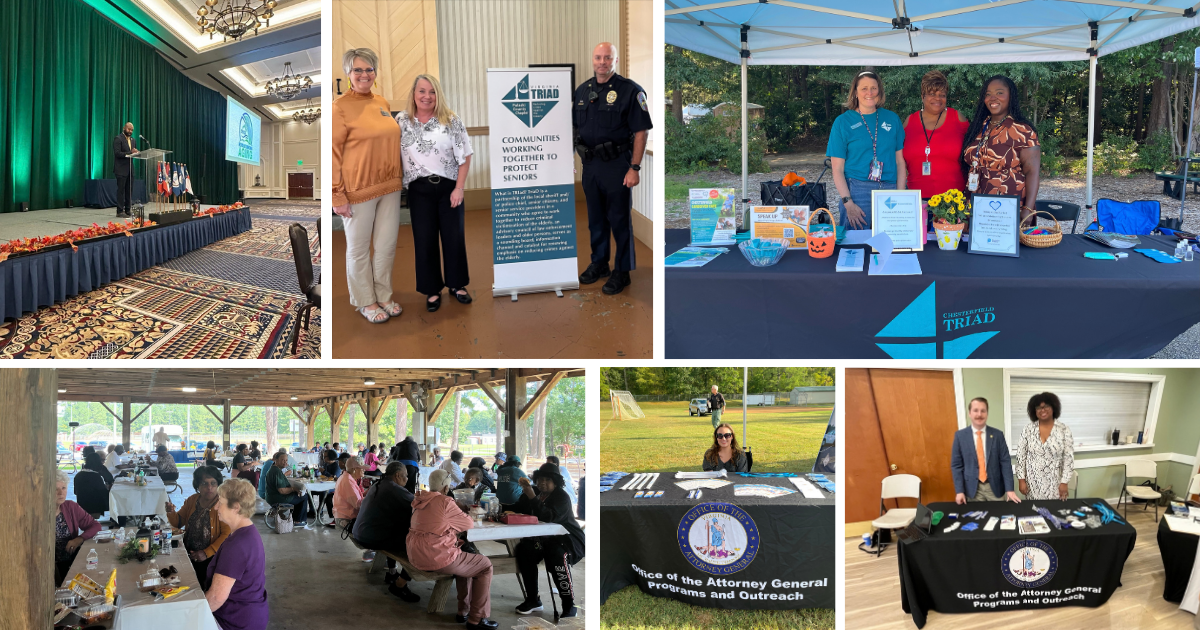
The Office of the Attorney General’s Outreach team is the local point of contact for communities across the Commonwealth. Coordinators and Community Liaison Officers (CLOs) connect with residents and local leaders, educating and informing Virginians on the resources and work being done by the Office.
TRIAD is a cooperative effort of law enforcement agencies, senior citizens, and senior organizations, focused on reducing crimes against seniors and the OAG’s CLOs work closely with TRIAD chapters across the state. CLO Taylor Davis tabled with the Chesterfield TRIAD at an area farmer’s market and attended the Prince George TRIAD yearly picnic. TRIAD Coordinator, Ben Bickel, and CLO Ajashu Thomas were at the Front Royal/Warren County TRIAD Senior Expo. MFCU CLO Randy Davis updated Petersburg TRIAD on recent MFCU cases and he was joined by CLO Taylor Davis at a Henrico County TRIAD meeting. The Pulaski County TRIAD welcomed CLO Amy Duncan to meeting.
CLO Ajashu Thomas attended the Shenandoah County Fair Senior Day. CLO Lara Bussert tabled at Rockbridge County’s National Night Out. CLO William Shackleford spoke at the Southeastern Association of Area Agencies on Aging (SE4A), which represents nine states and had 500 people in attendance. He also participated in the Chesapeake Sheriff’s Office & Chesapeake Sheriff’s Hope Foundation Senior Support Summit.
Published on: October 9, 2026
###